Flexible Value Proposition
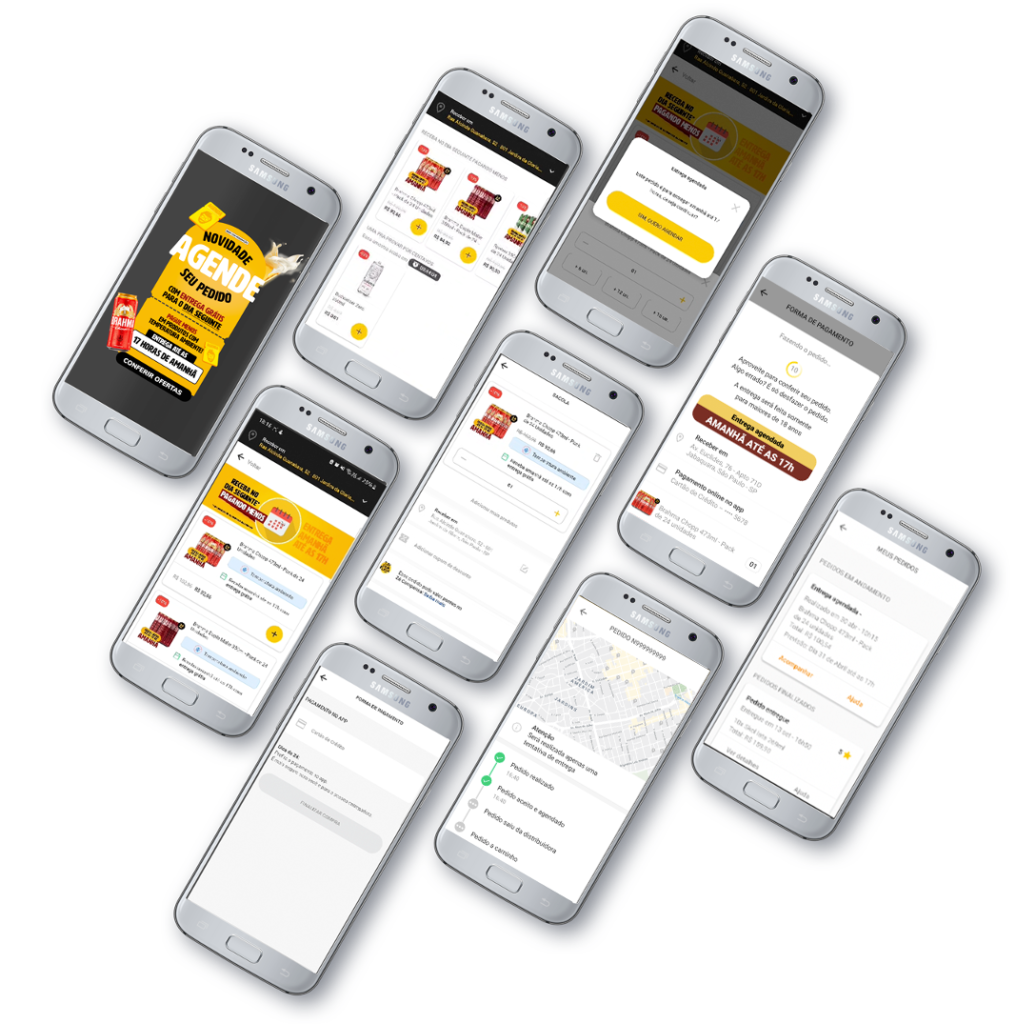
In order to achieve a integration between Ambev’s D2C to B2B (the biggest beverage company in the world), our objective was: elaborate a Flexible Value Proposition plan, to deliver a scheduled delivery functionality for the consumer on Zé Delivery App. To do this, we could deliver orders via Ambev logistic net, increasing revenue levels of the company via supply chain – and also, selling Chopp Brahma on the platform.
Continuous discovery
process (1)
Diverging: Empathizing with data
• Market size opportunity
• Gather research available
• Shadowing (field research with non-users)
• User interview
Defining the journey
• Benchmark
• Ideation and iteration
• Operations setup
• Usability testing
Converging: building and measuring
• Operation setup
• Metrics defining
• Business rules
• Rollout
Big picture: market opportunity size - online drink sales (mm)
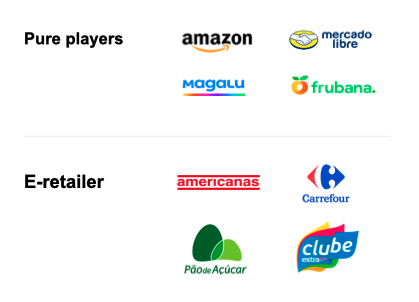
Together, pure players and e-retailers detain R$349mm ytd sum – and they are incresealy growing.
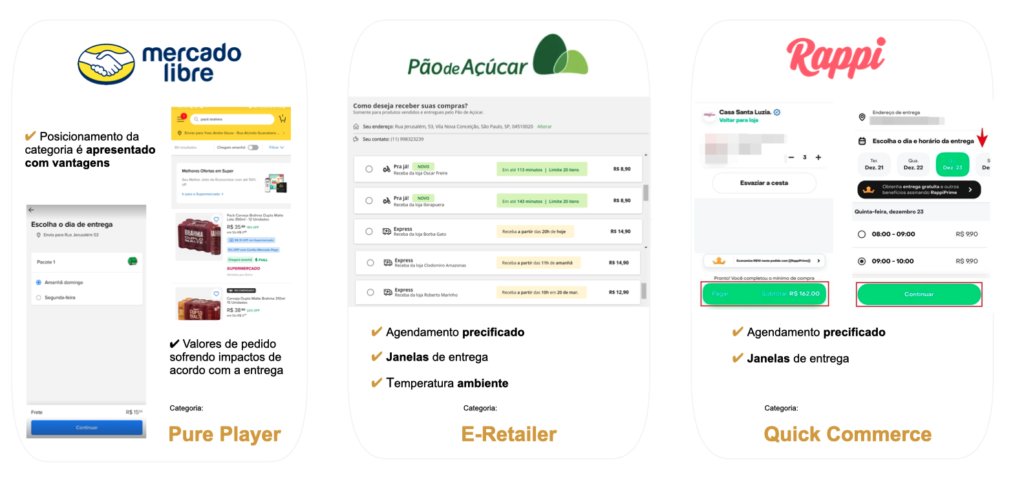
Service characteristics:
✔ Warm beverage
✔ Free shipping on next day delivery / schedule
✔ Promotion / Low price to persuade the user
✔ Mixed portfolio
✔ Charged delivery with fixed window / hours
Building rapport: understanding the value of Shipping service to the consumer via moderated interview
Context: We need to analyze in depth the user’s perception of using the term ‘shipping’ in the app
Research objectives: Measure the perception of value in relation to the ‘Delivery’ service. Understand pains and desires of the delivery service, better explore the relationship between Zé and consumer person who has a characteristic only of Expense, via qualitative interviews.
Who I wanted to talk to: No users, new users, recurrent users, lovers
Intro - icebreaker 🧊
• How long have you been ordering drinks per app?
• How is your day when you order ? Do you plan a event?
• How many orders do you place per month?
• Do you usually order from any other delivery service?
• What is the worst part of buying from the market?
• Do you ever leave a order, or give up on it due the shipping price?
Feel and think questions 💭
• What do you feel when you see us change the word Shipping to Delivery in the app?
• What are your thoughts on Zé Delivery’s delivery service?
• What do you think of Zé’s delivery time?
• How can a delivery service add value to you?
Listen and see questions 👂🏼
• What is your perception of the values described when closing orders?
• Have you ever discussed delivery fees by ordering drinks with friends?
• The information in the app is enough for you, do you miss something?
• How was the experience with Zé’s delivery people?
Does and Talk questions 🗣️
• Would you accept paying less for a delivery without prioritization (one, two days with no defined time frame?
• Would you accept to pay more for a priority or turbo delivery, being sure that you would receive it in the stipulated time?
• If you find the same product in Zé, in an advertisement / market communication: you buy it in Zé or in the Market (with a Delivery value of R$5.49). Why?
• Have you ever had problems with weight, or had to place an order again because of the volume of orders under the guidance of the store?
• Rate Zé Delivery’s service from 0 to 10
Patterns 🔎
– We observed that 16 of 20 participants believe that Zé can add value with the delivery service. This means that we can test different variable models.
– We observed that 12 of 20 participants do not discuss the value of deliveries when they are among friends. This means that there are different use cases to explore.
– We observed that 3 of 20 participants plan their purchases. This means that they do them casually, through stimulation (offer).
– We observed that 10 of 10 participants feel that they need some improvement in the delivery journey. This means we can test flow and route planning improvements.
– We observed that 16 out of 20 participants do not prefer to buy in the market for reasons of convenience. This means that they think the value of the product is more important than the delivery.
– We observed that 18 of 20 participants understand the values described when closing orders. This means that the existing information in the app is clear to the user.
Insights 💡
– Based on the subject that we can add value to the delivery service, an insight is: planned, turbo and standard (bundled) deliveries are valid hypotheses.
– Based on the subject that delivery value is not discussed in a social occasion, an insight is: we can test different options associated with planned events.
– Based on the issue of purchasing without prioritizing delivery, an insight is: we can add this value proposition to the planned delivery.
– Based on the subject that the user can choose for shopping places, an insight is: we should focus on Zé’s differentials and add them as value.
Important transcriptions 🔊
Operations Setup: generating value proposition
It’s all about validate a logistic business model integrated with Ambevtech / Bee’s, so we need to propose to the consumer offers with the same characteristics in both ecosystems, and also carry the insights gathered on the interviews. Check the 6 decision items bellow:
We select 13 sku’s to sell on this category, attending a variable criteria (from NAB to Ready Drinks instead of only Beer). This point comes from the observation of user research – if they stock and order scheduled products, they have adherence in different kinds of categories of products.
We defined a limit for the number of packs, to not overload the shipping process and to not represent a problems between DTC x B2B clients. Considering a cheaper offer, users could be benefit her to different reasons.
Warm – not cold drinks, trying to validade a economy on the refrigerating cost, witch is one of highest on the supply chain system. Also, attending to AmbevTech / Bee’s model.
Regular fee’s, in order to not interfere on others promotions and initiatives on the app, clearly selling items with discount due the temperature of the products.
Considering 2 business models, divided by casual and scheduled orders (and the respective sub-categories), we decided do move on next day model, delivering others up to 5pm, respecting 10km of radius from the store.
Online payment only – assuring that we would not loss money with undelivered items, wrong address and cancelled orders.
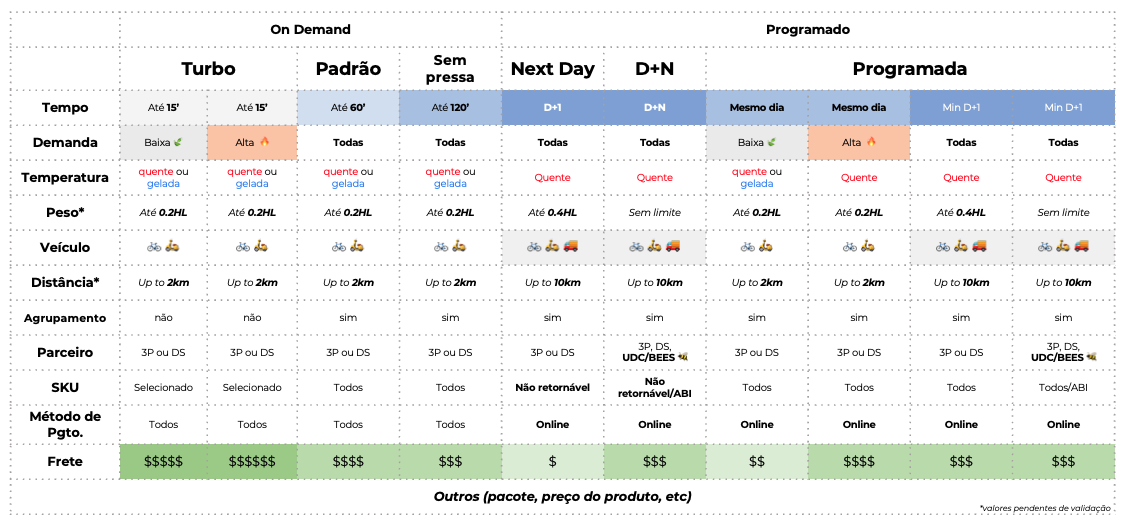
New use cases study: analyzing the complexity and defining the starting point
Testing Local
Dark Store Jabaquara
• Expanded radius (serving South of SP)
• Delivery time from 10am to 5pm
• DS service radius: up to 6km (current average ~4km)
• Receiving orders until 0am
• Using cars on operation
Dark Store Brás
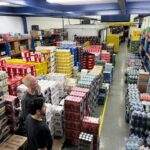
• Expanded radius (serving the West and Central Zone of SP)
• Delivery time from 10am to 5pm
• DS service radius: up to 6km (current average ~4km)
• Receiving orders until 0am
• Using motorbike on operation
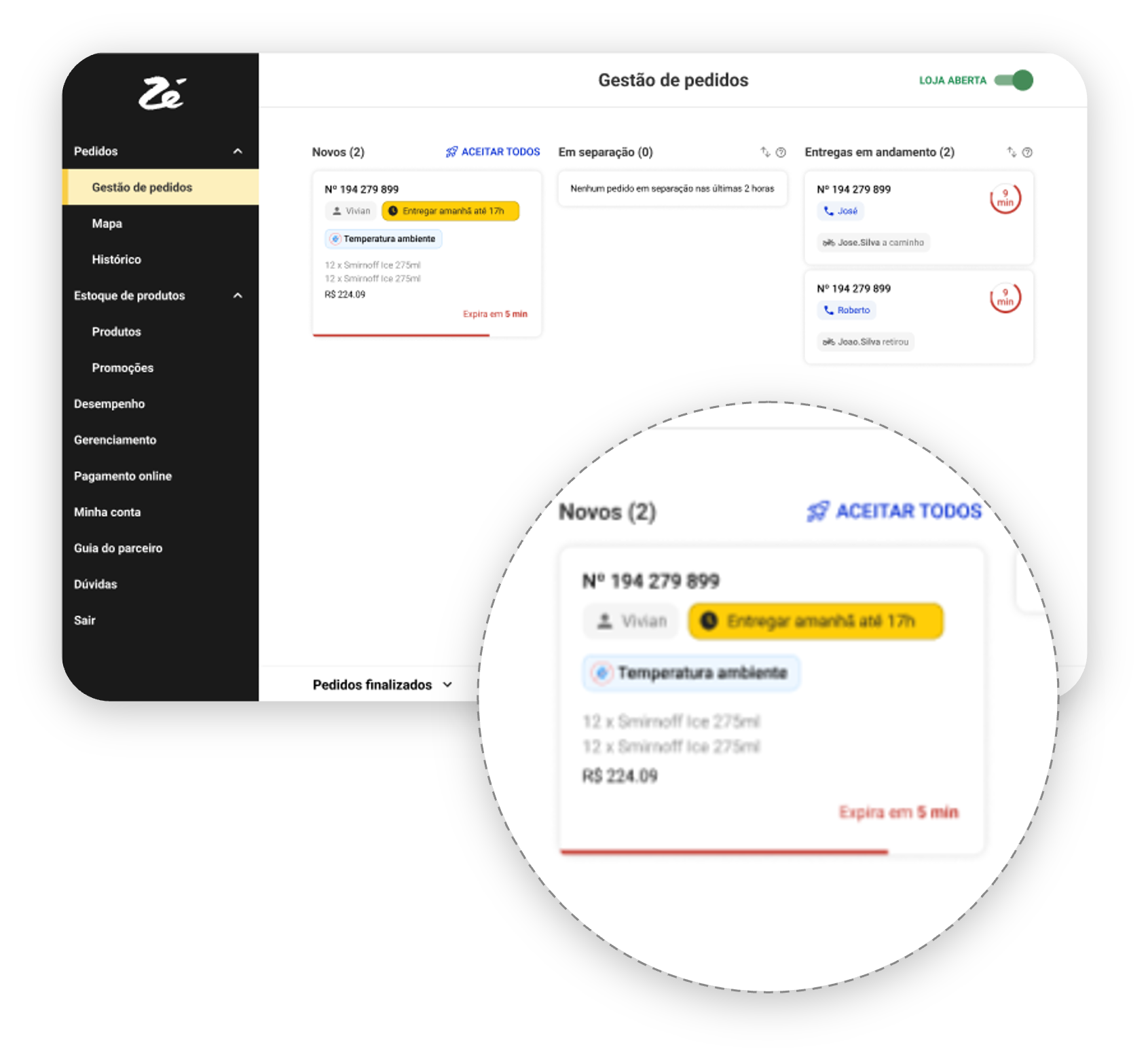
Seller interface, receiving information about the Next Day Delivery with a new component
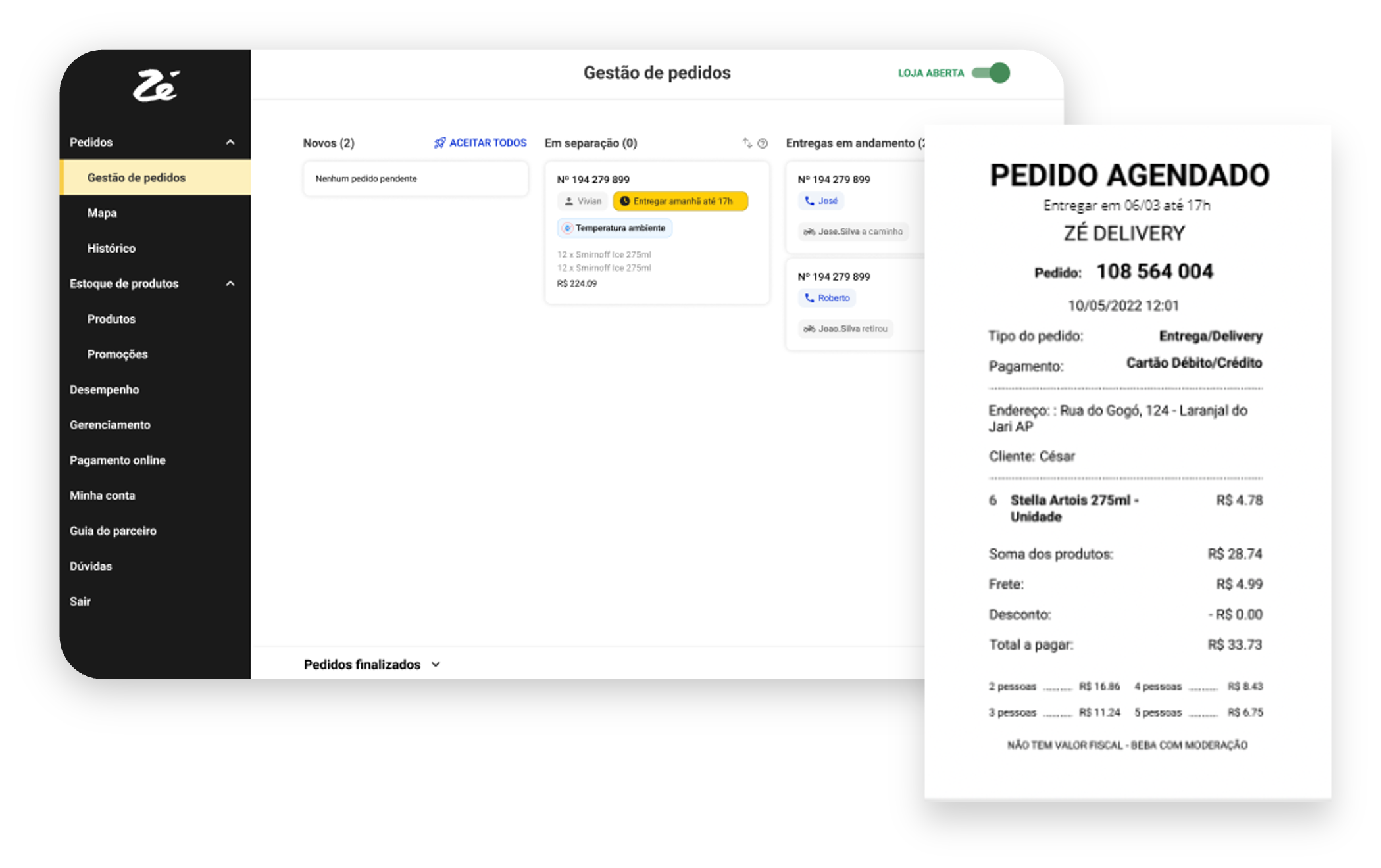
Outgoing order, printing the information in the delivery invoice to inform the courier and the seller
Continuous discovery
process (2)
Diverging: Assisting the operation
• Operation crashes
• User behavior
• Area coverage
• Ongoing learnings
Transforming data to insights
• Closing numbers
• Screen recordings
• Quantitative research
• Next Steps
Converging: Scaling the operation
• Preventing cancelled orders
• Avoiding Address mistakes
• No-code and Low-code testing
• Handover new user flow
What went wrong? What went well?
• A considerable increase of Fill Rate metric 📈
• 57% of cancelled order by consumers ❌
• 80% of cancelled order due timing ⏱️
• 14% of cancelled by order expired 👀
05/25 - 06/18
Operation learnings:
• Expired orders made us build a bot to automatize the acceptance;
• Concentration of the test in a single store with a radius of 10KM (centralization);
• A dedicated Van doesn’t correspond to the total volume of orders;
• Stocking warm products is a challenge
___
Consumer learnings
• Consumers did not understand the new purchase occasion (high cancellation rate);
• Occasion needs to be built over time, consumer enters Zé for quick orders (low adherence / number of orders);
• Basket/mix does not differ from the casual occasion.
Screen recordings: watch real users navigating (UXCam)



Sessions recorded: 3.866
Average navigation time from login to checkout: 3 to 5 min*
Most visited sessions: Beers card, Search box and Banners
Behavioral analysis: The user is adept of the casual ordering. He always seeks for price advantages, better conditions of shipping and lowest costs. He doesn’t have a long time of navigation, usually it comes to the app to decide the purchase. The only time that he spends on the showcase is searching for cheap products, knowing that the order will be delivered very fast. So, and a hyphotesis here is: the actual user is adept to what the app offers, not to the new value proposition.
Note: all the cancelled orders had average SLA of 30 min – confirming that the user was waiting the order, so when realized that it not comes, cancelled it.
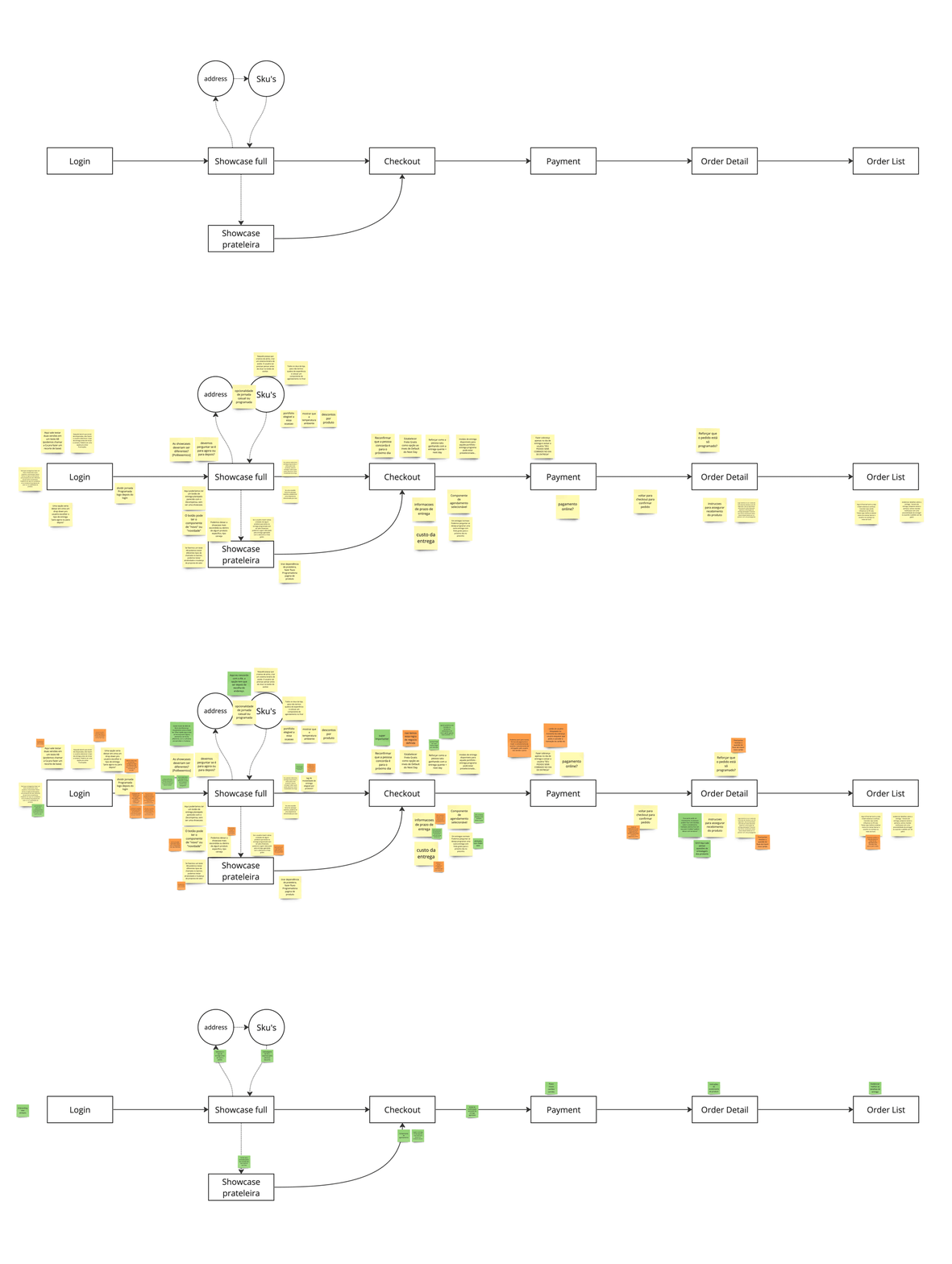
Click paths:
• Main showcase
• Next day Showcase
• Checkout
• Payment
• Order Detail
• Order List
Time to research: investigate the boundaries of the test
Context: We need to understand the impact and visibility of the new feature to users.
Research objectives: Measure the perception of the ‘Schedule’ feature. Understand how many of them realized that it exist, how many of them considerate through Quantitative Research.
Who I wanted to talk to: New users, recurrent users, lovers of São Paulo city
Did not realize that there is a schedule feature
of who realized, considered to schedule a order
Scheduled a order
Ideating and dealing with de cancelling and adherence problem
Considering all the data above, we run a dynamic between Revenue, Operations and Last Mile team to address two points: Order cancellation and Adherence, with the purpose to hyphotize solutions end-to-end based on the user flow (since login to receiving order).
First step: Solutions
Second step: Objections
Third Step: Reforge ideas
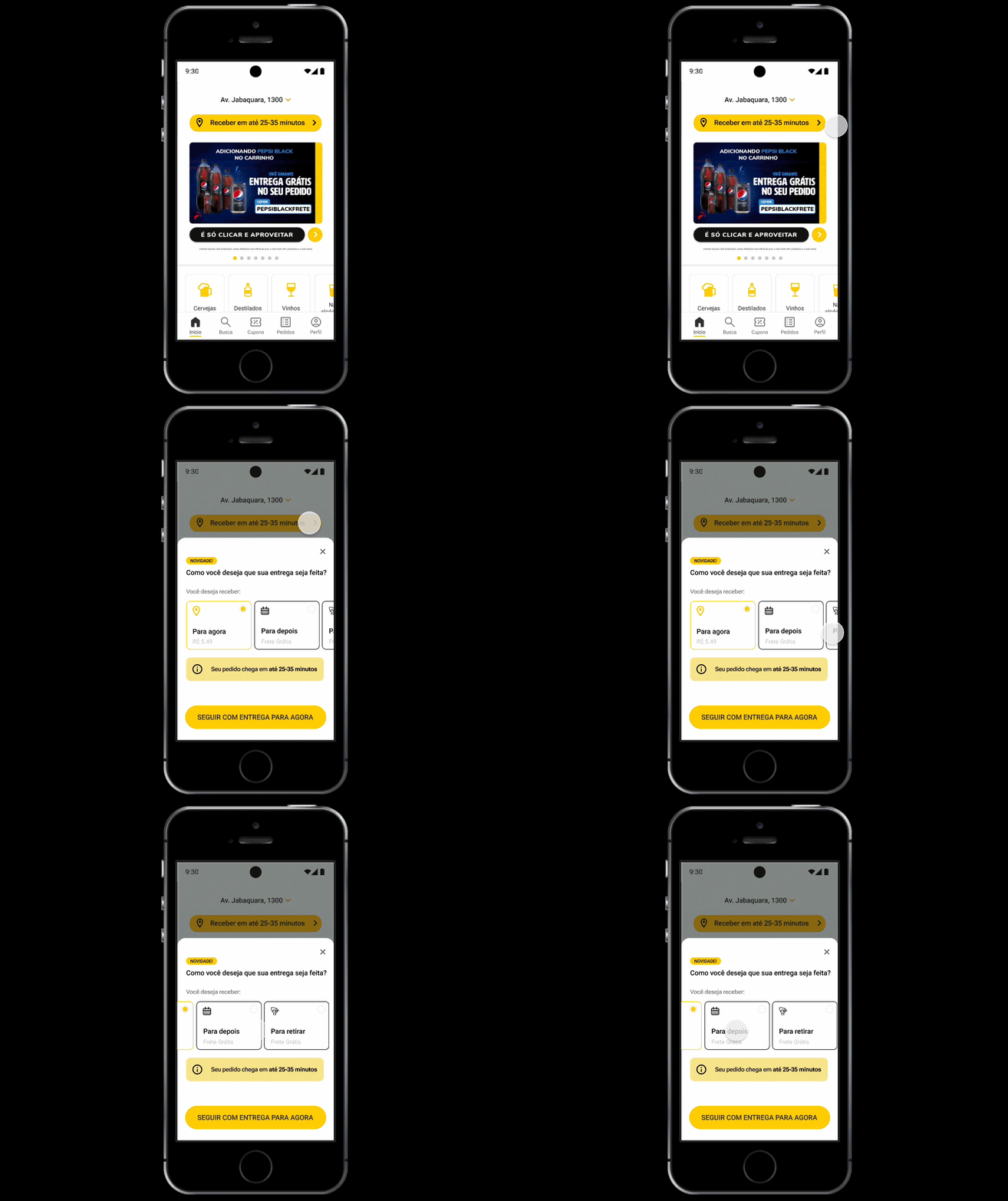
To upsell the feature and according to all benchmark that was made, we decided to propose a new component under the Address selector called Delivery Method, in the beginning of the flow. The idea here is to create a new section, allowing different shipping choices do the user, and increasing new features as we evolve a future vision to Zé Delivery app.
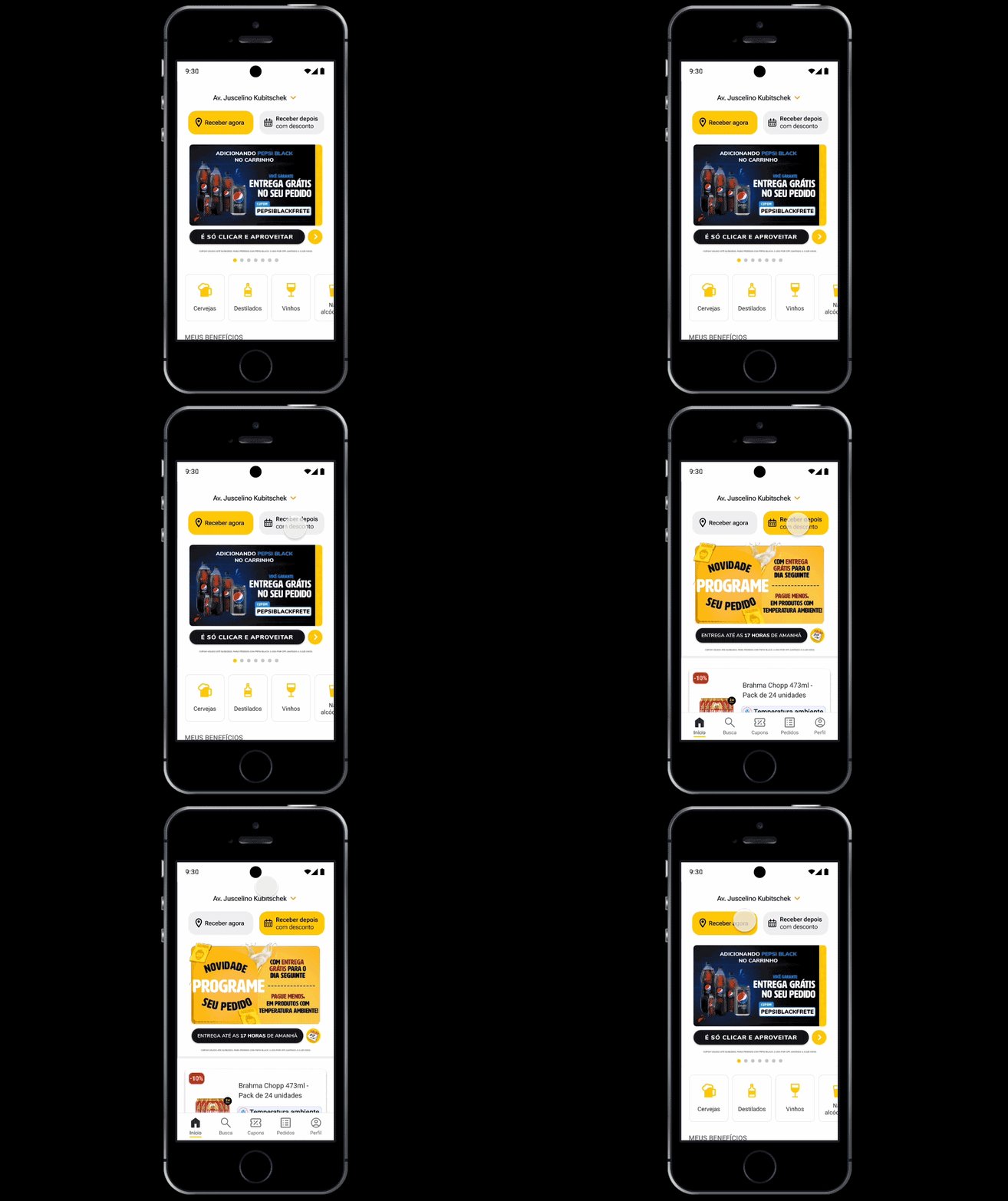
Trying to be more ‘straight to the point‘, we designed hypothesis B keeping the the component in beginning of the flow, but instead a new area, only a tab component with a supporting information ‘receive tomorrow with discount’. The purpose here is to test a more engageable version, eliminating one step of the flow.
How to decide: No-code and Low-code testing
To ensure the better hypothesis rollout, we developed 2 tests: one is no-code, and another is low-code for quick validation. The first, a usability test, the second, a Fakedoor disguised as a ‘teaser’ – both in the limit of the MVP area (São Paulo State). The point is: we need to move forward with data, statistically saying. Crossing the number, we would ‘roll the dice’ in the better hypothesis.
Non-moderated usability test 📲
Method:
The survey was launched on 03/08 (Thursday) – 12:00 to São Paulo State in A/B model, dividing the base and sending a prototype hyphotesis to each. The objective was to research following points :
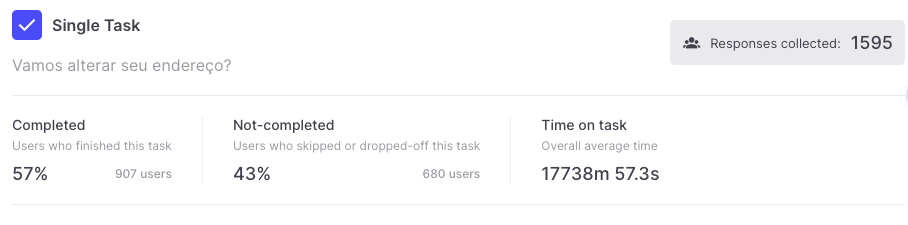
– Address changing
– Selection of delivery model
– Understanding the value proposition (warm beverage, delivered next day until 5pm)
Who I was talking to:
– Active, recurring, C0, Zé Lovers, Drinkers and Cross* users
Engagement numbers:
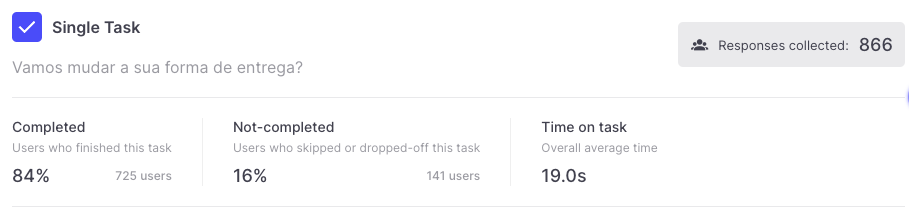
Hyphotesis A – 2124 accesses, 27% conclusion rate (549 users), 5m 15s average conclusion time
Hyphotesis B – 2293 accesses, 30% conclusion rate (651 users), 3m 35s average conclusion time
Results:
Hyphotesis A
Hyphotesis B
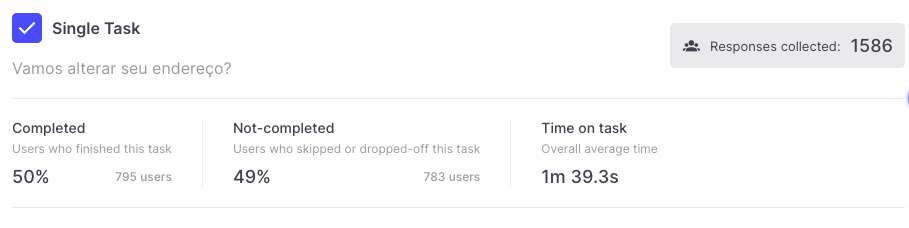
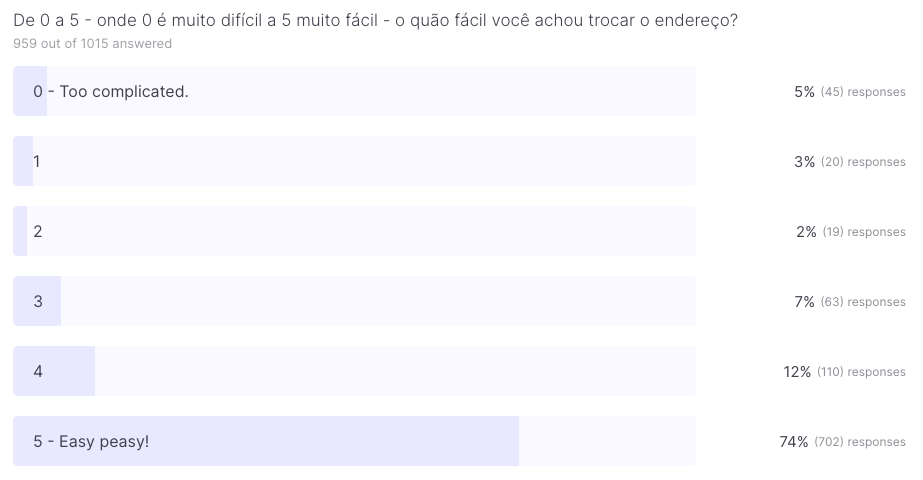
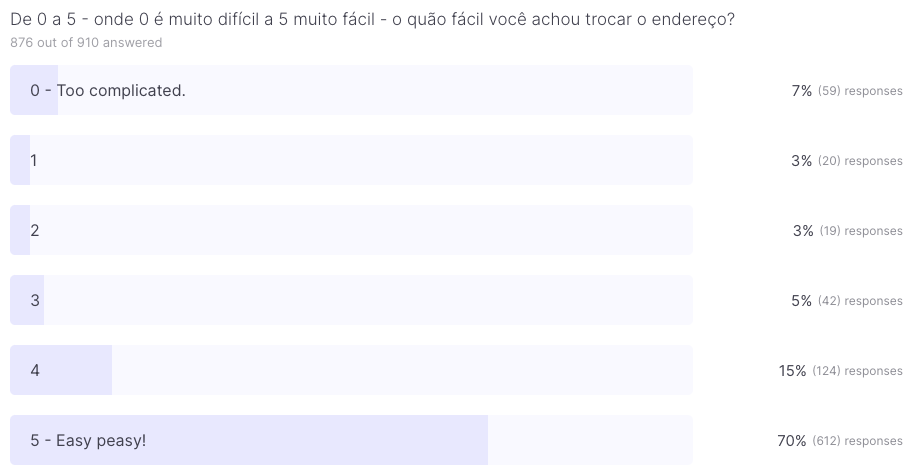
In the 'Time to complete' and 'SUS score', we see a little difference pointing Hypothesis A as easier to understand the address change proccess.
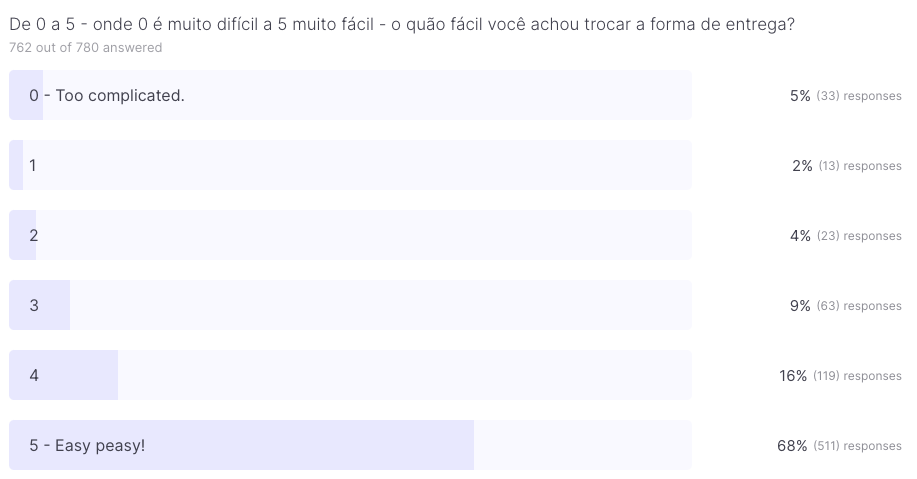
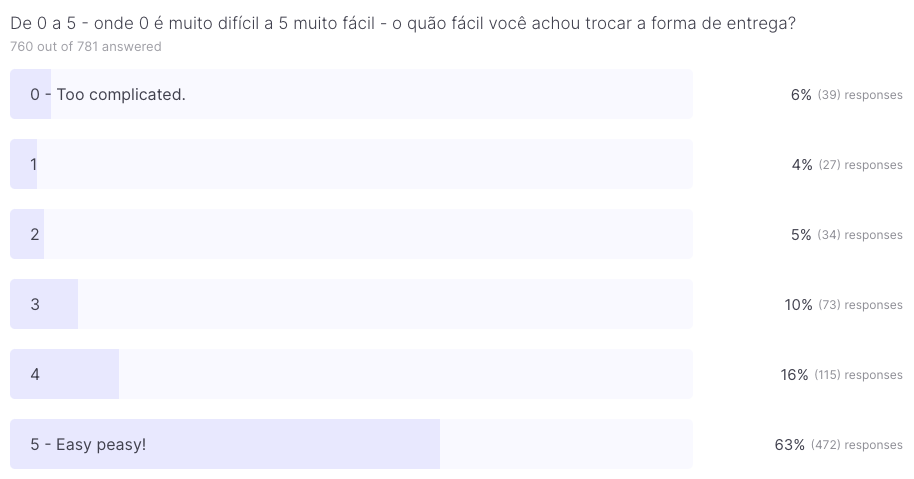
Hyphotesis B always win on 'Time to complete', but...
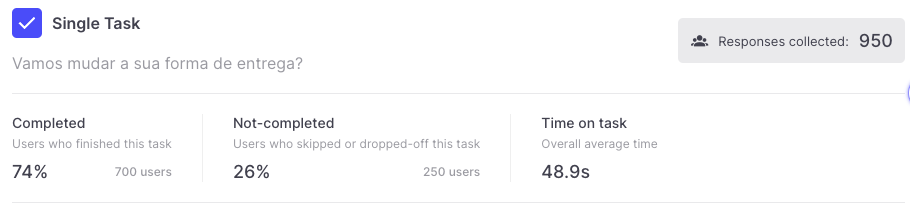
It always lose on 'SUS' score like on the example above, when we ask about the difficulty to understand the process to change the delivery model
And now, the decision-maker data: Hyphotesis A is considerable easier to understand when we talk about Value Proposition (warm beverage, delivered next day until 5pm)
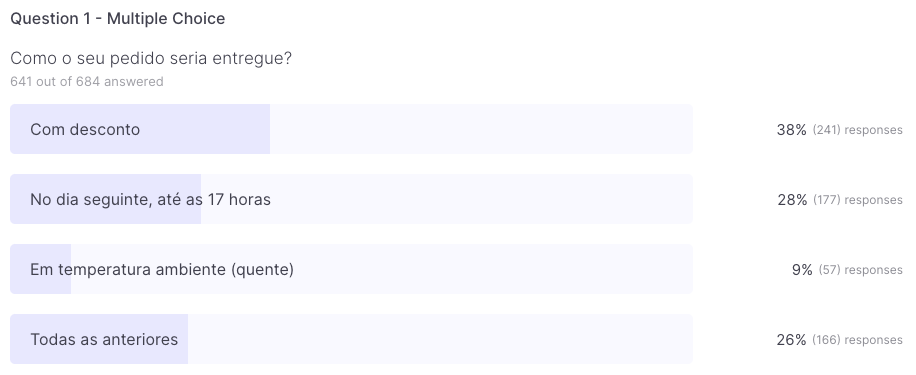
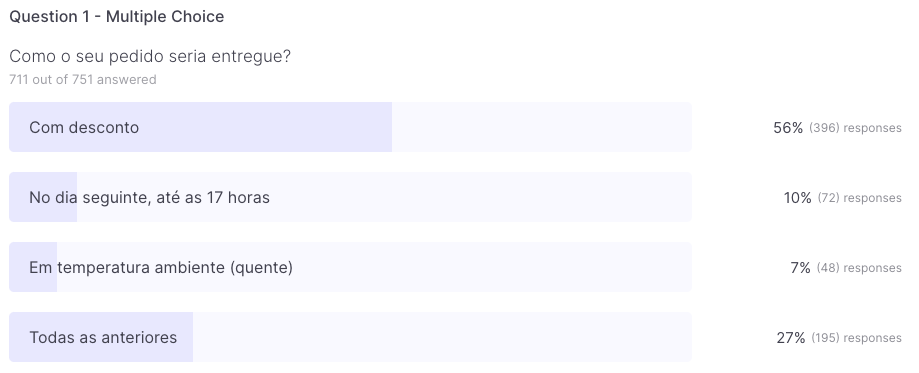
Conclusion: Hypothesis A takes advantage of data when it comes to user interpretation. There is an assumption that the micro interaction in the component may have helped in this cut, and also an extra step in the flow helped the user to better understand the value proposition.
Fake door (Disguised as teaser) 🆕
Method:
To fast validate and generate quick learnings, we developed a strategy to fragment the engineering process: instead of producing the whole flow, taking time and effort, we decided to deliver only the first part of it – the Delivery Model component. The objective: implement a fake door, measuring clicks per unique login, and cancellation problems (due address changing).
KPI’s:
Order Cancellation (WtW)
Average clicks per unique user
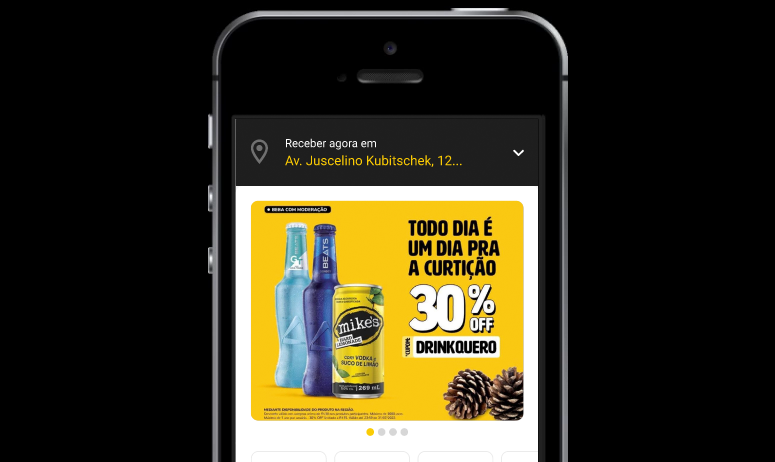
Actual Topbar
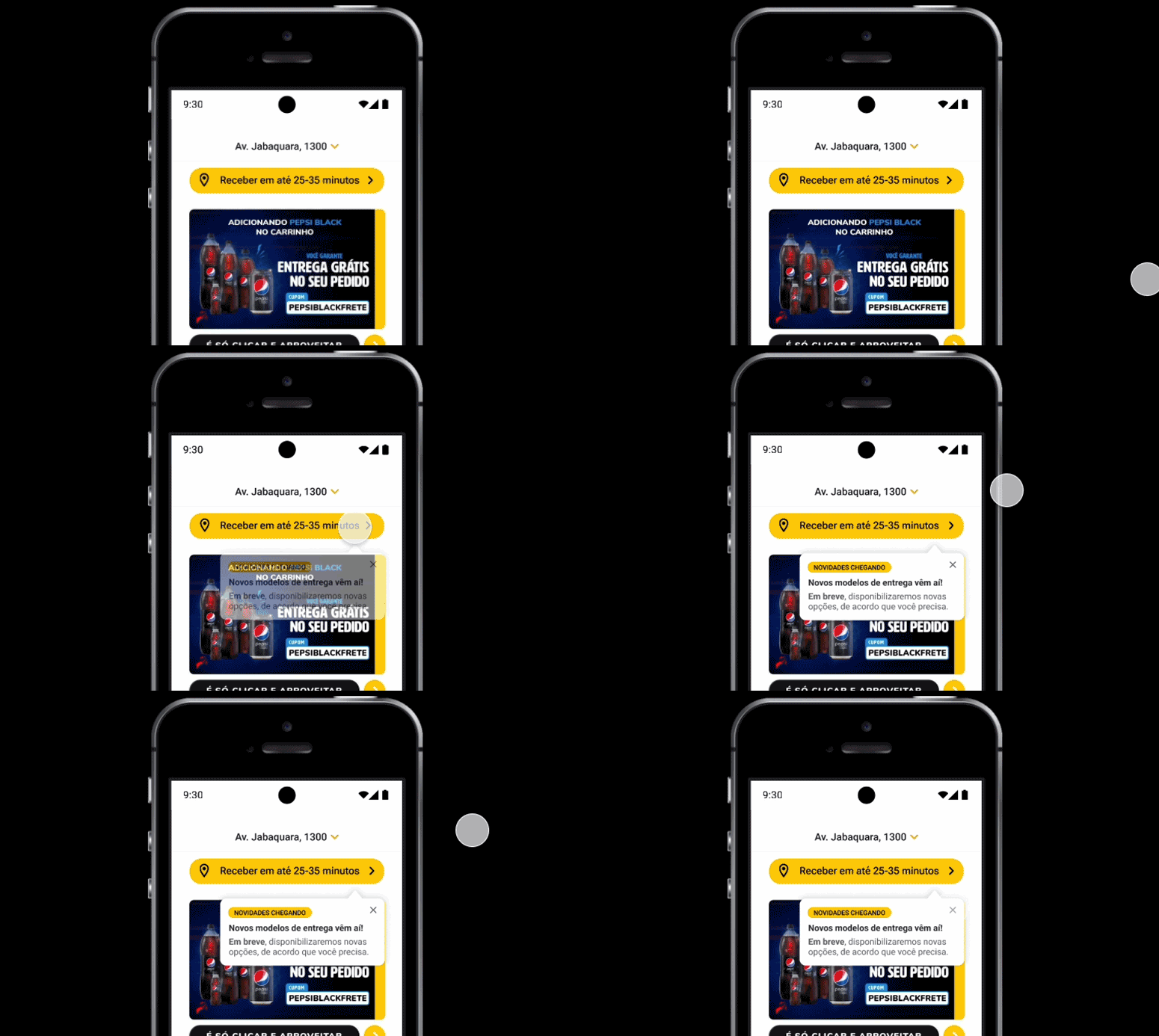
Hyphotesis A Topbar
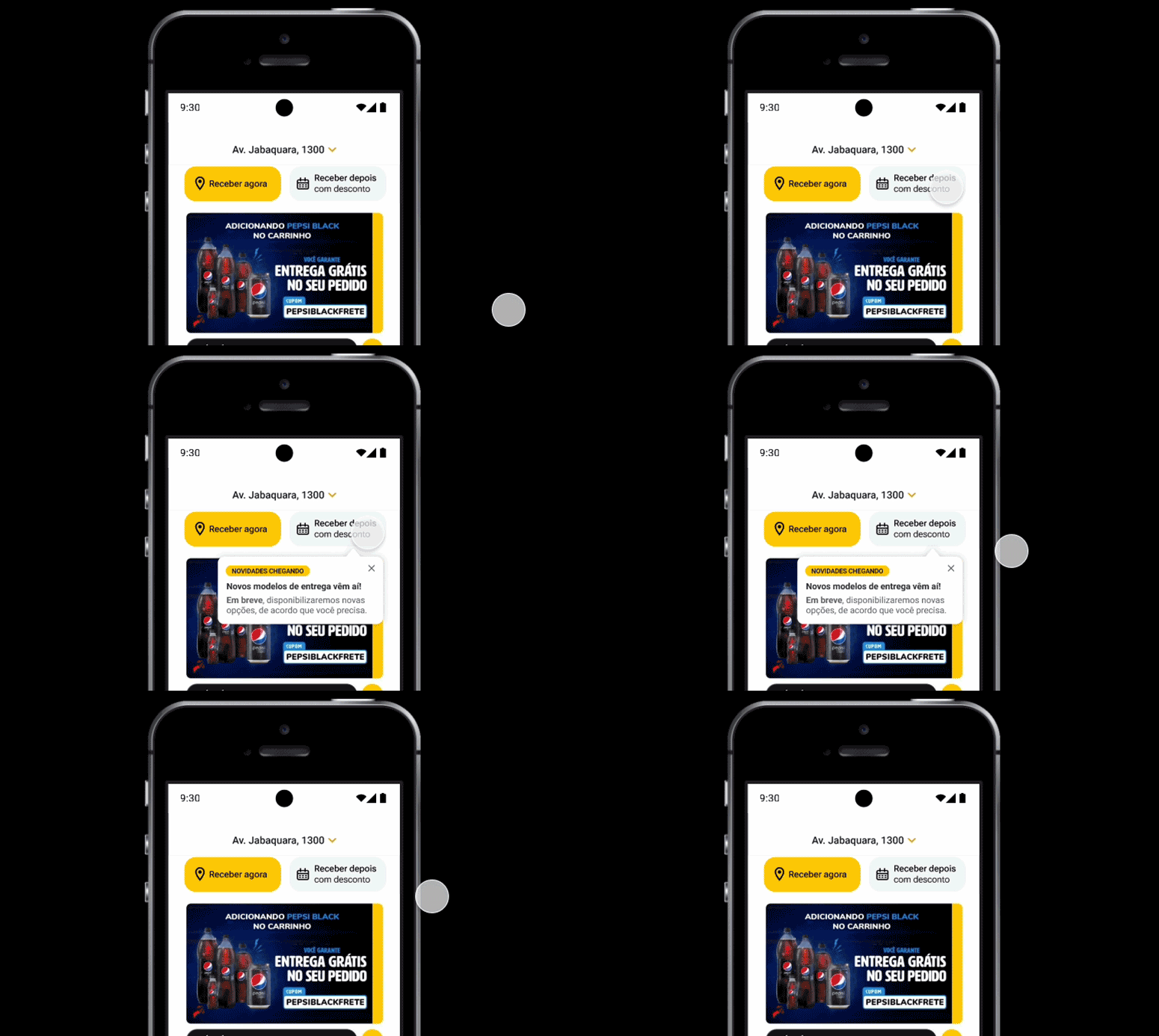
Hyphotesis B Topbar
Results and Next Steps
The main point here is to cross data between the no-code and low-code test, to ensure and implement the new Topbar in the app. And after that, we would surely keeping our Continuous discovery process, finding ways to reach our objective witch is deliver new use cases in the app Zé Delivery.
Also, through this process, we could prove to stakeholders that the new schedule feature may not correspond to increase order volume KPI, due the actual value proposition (cold, fast and cheap beverage). But according to discovery data, we can achieve another important KPI: New users 🫶🏼
Updates will be ready soon on Zé Delivery app.
